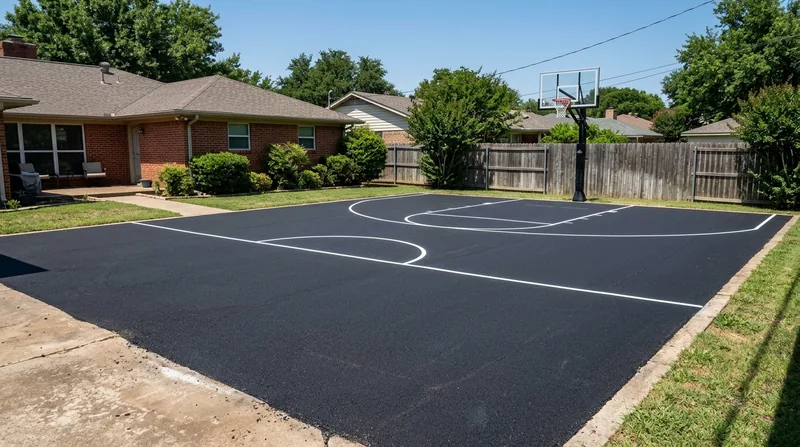




Sports Court & Path Paving in Dallas requires a foundation that can handle the clay movement and seasonal moisture swings that define North Texas. Tennis courts, basketball courts, and recreational paths across Dallas sit on deep black clay over Austin Chalk limestone, the same expansive soil that cracks and shifts driveways across Oak Cliff, Lakewood, and the ranch subdivisions of East Dallas. When that clay swells in spring and pulls back in summer, an improperly prepared base fails fast, leaving your court or path cracked and unplayable within a season. We grade and compact the aggregate base, pour hot mix asphalt, and pitch the surface so water clears before the next storm. The result is a flat, durable playing surface built to move with the ground beneath it, not fight it.
Why Sports Court & Path Paving Matters in Dallas: Clay Movement and Drainage
Dallas sits on some of the most challenging soil in Texas. The black clay that underlies Collin, Denton, Tarrant, and Dallas counties expands when wet and contracts when dry, moving as much as two to three inches vertically over a single wet-dry cycle. A court or path built on an unstable or poorly drained base will crack, settle unevenly, and become unsafe for play within months. Proper base preparation, compaction, and surface pitch are not optional extras, they are the only way to build a court that lasts.
- We excavate and grade the subgrade to remove soft clay and standing water pockets that trap moisture.
- We place and compact aggregate base material in lifts, proving compaction with field testing to ensure stability under load.
- We pour hot mix asphalt at the correct temperature and thickness, pitched to shed water away from the playing surface.
- We finish the surface smooth and level so the court plays true and water does not pool.
Courts and paths built this way handle the Dallas climate and stay playable for years. Courses built with shortcuts or on bare clay fail fast and become expensive to repair.
Key info: In subdivisions across North Dallas and into Collin County, HOA-owned courts and community paths often sit in low spots where drainage is poor. If your court is in a drainage low point, we add a swale or grade the surrounding grade to keep water from pooling at the edges. Check your HOA architectural guidelines before we start, as some master-planned communities control the material and finish of recreational surfaces.
For more on how we prepare bases for any asphalt surface in Dallas, see our work on gravel driveway installation and grading, where base preparation is the same foundation principle.
How We Build a Sports Court or Path: Step by Step
A court or path that plays true and drains well starts with honest site work. We walk the lot, identify the low spots and high spots, look at how water moves across the property, and plan the grade and pitch before we move any dirt. The goal is a stable base under a level, well-pitched asphalt surface that sheds water and handles the clay movement below.
- We mark out the court or path boundaries and identify utilities with a Texas 811 locate call, which is required by law before any excavation.
- We excavate to the required depth, remove soft or organic soil, and grade the subgrade to the design elevation.
- We place compacted aggregate base (usually 4 to 6 inches of crushed stone) in 2-inch lifts, compacting each lift to 95 percent density or better.
- We proof roll the base with a loaded truck to verify it will not settle under the weight of play and foot traffic.
- We pour hot mix asphalt at the correct temperature and thickness, typically 2 to 3 inches for a recreational court or path.
- We finish the surface with a smooth trowel or roller, pitching it 1 to 2 percent so water runs off and does not pool at the edges or center.
From start to finish, this process takes three to five days for a typical court, depending on the size, base condition, and weather. The surface can be walked on after 24 hours and played on after 48 to 72 hours, depending on temperature.
Local example: A homeowner in McKinney wanted a half-court for his kids. The lot sloped toward the house, so we graded it away from the structure, compacted a 5-inch base, and poured 2.5 inches of asphalt pitched to a drainage swale on the downhill side. The court has been level and playable for three years. The key was getting the base stable and the pitch right from the start.
For a detailed look at how we handle the base work that underlies any asphalt surface, including courts and paths, see our asphalt driveway paving service, where the same principles apply.
Sports Court & Path Paving Methods and Materials
| Approach | Description | Best for |
|---|---|---|
| Full-depth court construction | Excavate to subgrade, place compacted aggregate base, pour hot mix asphalt at full thickness, finish smooth and pitched. | New courts, paths, or sites where the existing ground is soft or has poor drainage. |
| Court resurfacing | Mill off the top 1 to 2 inches of an existing court, inspect the base, and pour a new wearing course. Base is reused if stable. | Courts that are cracked or worn but have a solid, well-draining base underneath. |
| Base repair and re-pitch | Identify low spots and settlement, add base material, recompact, and repour the asphalt surface to correct pitch. | Courts that hold water or have settled unevenly but do not need full replacement. |
| Drainage and grading | Regrade the surrounding area, add swales or berms, and pitch the court surface to move water away from play areas. | Courts in low spots or where standing water is a recurring problem after rain. |
Sports Court & Path Paving Cost in Dallas: What to Expect
A recreational court or path in Dallas starts at $8,500 and moves up from there based on size, site condition, and drainage work required. A 2,500-square-foot half-court with a stable base and good drainage might run $12,000 to $16,000. A full court with extensive grading, base replacement, or drainage work can reach $25,000 to $35,000 or more. The biggest variables are the size of the court, the condition of the existing subgrade, how much base material and compaction is needed, and whether you need to grade the surrounding area to shed water.
Getting a written estimate on site is the only honest way to know the cost. We measure the court, dig a test pit to look at the soil and drainage, and give you a number that includes the base work, asphalt thickness, and finish. Call us at (469) 949-4815 for a free estimate, no obligation. We respond within 24 hours.
For a full breakdown of pricing on other asphalt services, including driveways and parking lots, see our pricing page.
Sports Court & Path Paving Near Me: What Dallas Homeowners Should Know When Hiring a Contractor
Hiring a paving contractor for a court or path is a straightforward process if you know what to ask. The contractor you choose should be local, insured, and willing to give you a written estimate that spells out the base work, asphalt thickness, and finish. Ask for references from other courts or paths they have built. Check whether your city or HOA requires a permit or architectural approval before work starts. If your court is in a master-planned community, your HOA likely has rules about the material and finish, so verify those before you get a bid.
- Verify that any contractor you hire is fully insured and can provide a certificate of insurance before work begins.
- Get a written estimate that includes the subgrade work, base material and depth, asphalt thickness, and finish specifications.
- Ask for references from other residential courts or paths the contractor has built in Dallas or nearby, and call them.
- Check with your city or village to see whether a permit is required for the court or path, and whether the contractor or the homeowner pulls it.
- If your court is in an HOA community, confirm that the material and finish meet the architectural guidelines before you sign a contract.
- Make sure the estimate includes a Texas 811 utility locate, which is required by law before any excavation.
A contractor who is local, insured, and willing to show you the work in writing is the one who will build a court that plays true and lasts. Contact us for a free estimate and a walk-through of your site.
Sports Court & Path Paving in Dallas: Pricing Guide
| Service | Price | Details |
|---|---|---|
| Half-court (2,500 sq ft) with stable base | Starting at $12,000 | Includes base preparation, compaction, 2.5-inch asphalt pour, and proper pitch for drainage in Dallas |
| Full court (5,000 sq ft) with site grading | Starting at $22,000 | Includes excavation, base work, asphalt pour, and pitch correction to shed water from clay soil movement |
| Path or recreational surface (1,000 to 2,000 sq ft) | Starting at $8,500 | Includes base prep, aggregate compaction, and asphalt finish with drainage pitch for North Texas clay conditions |
| Resurfacing existing court or path | Starting at $6,000 | Includes milling worn surface, base inspection, and new asphalt wearing course if base is stable and sound |
| Drainage or base repair | On estimate | Grading, swale work, and base replacement require site inspection to determine scope and material needs |
| Free estimate and site walk-through | No charge | Response within 24 hours at (469) 949-4815; includes soil inspection, drainage review, and written quote |
Indicative pricing, the exact cost depends on square footage, finish, and site access. Free personalized estimate within 24h at (469) 949-4815.


