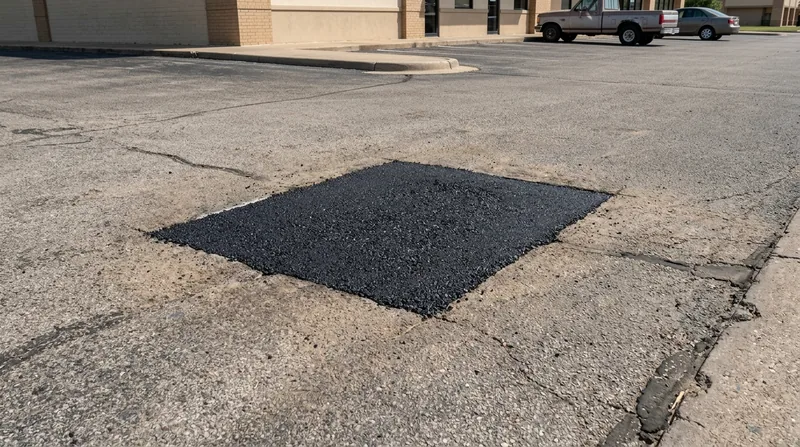




Spring hail and sudden downpours leave pothole repair and asphalt patching as the most urgent maintenance call across Dallas driveways and parking lots. The black clay that sits beneath most of the metropolis swells when wet and shrinks in summer heat, opening seams where water pools and freezes, turning small cracks into widening holes. We cut back to solid base, compact in lifts, and patch with hot mix so the repair holds through the next storm. Whether your driveway in Oak Cliff, a parking lot in Arlington, or a drive apron in Frisco shows fresh potholes or spreading edge cracks, the fix depends on how much of the surface has failed and whether the base underneath is still sound. A single pothole or a few scattered soft spots can be patched; extensive alligator cracking across thirty to forty percent or more of the surface signals that resurfacing or replacement will be the better money spent.
Why Pothole Repair Matters in Dallas: The Spring and Summer Cycle
Dallas sits on deep expansive clay over Austin Chalk limestone. That clay swells when spring rains arrive and shrinks back as summer heat climbs past 100 degrees. This wet-dry swing is the single largest driver of pavement failure in the region. Hail storms pit the surface, sudden downpours find the smallest cracks and force water into the base, and freeze-thaw stress (rare but real in winter) widens the damage. Parking lots and driveways that were sound in July can show fresh potholes by March. The longer a pothole sits, the faster it spreads. Wheel traffic breaks the edges, water undermines the base, and a dime-sized hole becomes a six-inch crater in weeks.
- Spring hail and heavy rains create impact damage and standing water that forces into small cracks and expands them.
- Summer heat softens the asphalt surface and makes it more vulnerable to rutting and edge failure under traffic.
- Wet-dry cycles of the Dallas clay open new edge cracks along drives and parking areas every season.
- Early patching stops water from reaching the base and keeps small damage from becoming a full reconstruction.
Waiting for a pothole to "get worse" is a false economy. The cost to patch a pothole this month is a fraction of the cost to replace a failed section next year.
Key info: In Dallas parking lots and driveways, pothole damage accelerates fastest in spring (March through May) when the clay is saturated and traffic is heaviest. A parking lot in Irving or Garland can show five new potholes in a single week after a hail storm. Early-season patching prevents costlier repairs later.
For more detail on the full repair picture, see our driveway repair page.
How We Patch Potholes and Soft Spots: The Process
Patching is not filling. A pothole that is simply topped with fresh asphalt will fail again in weeks because the base underneath is wet, weak, or both. We remove the failed material back to solid ground, prepare a stable base, and compact new asphalt in layers so it binds properly and carries traffic. The work is straightforward, but the difference between a patch that holds and one that fails again is in the base preparation and compaction.
- We cut back the pothole or soft spot to expose sound base material, removing all loose, wet, or weak asphalt and subgrade.
- We clean the edges and bottom, removing debris and standing water so the new material will bond.
- We compact the base in lifts to restore load-bearing capacity and ensure proper drainage.
- We apply a tack coat to the edges so the new asphalt bonds to the existing pavement.
- We place hot mix asphalt in layers, compacting each lift to density so it cures hard and stays in place.
A well-executed patch on a sound base will outlast the surrounding pavement. A patch on a weak base will fail again.
Real example: A parking lot in Plano showed three potholes along the back apron after spring rains. The base was sound, the damage was localized, and patching was the right call. We removed the failed material, compacted the base, and set the patches in May. Two years later, those patches are still solid and the surrounding pavement has not failed. If the base had been compromised, we would have recommended a full overlay instead.
Learn more about the larger decision between patching and resurfacing on our asphalt resurfacing and overlay page.
Patching Methods: When to Use Each Approach
| Approach | Description | Best for |
|---|---|---|
| Full-depth patch | Remove all failed asphalt and subgrade down to stable soil, compact base in lifts, and set new hot mix to full depth. | Deep potholes, soft spots, and areas where the base has been compromised by water or traffic. |
| Skin patch | Remove failed asphalt only, leaving the base intact, and set new hot mix 2 to 4 inches thick. | Shallow potholes and edge failures where the base is still solid and well-draining. |
| Cold patch (temporary) | Place cold-mix asphalt (no heating required) into a pothole as a quick temporary fix. | Emergency situations or very small temporary repairs while a permanent hot-mix patch is being scheduled. |
| Overlay (if base is sound) | If potholes are scattered but the overall base is solid, mill the surface and apply a new asphalt layer across the entire area. | Multiple potholes across a large area, or when surface cracking is widespread but the base is still stable. |
Pothole Repair and Asphalt Patching Cost in Dallas: What to Expect
A single pothole patch starts at around $450 and moves upward based on depth, diameter, and whether the base is sound or compromised. A pothole that is four inches deep and two feet across costs less to repair than one that is eight inches deep with a failed base underneath. A parking lot with five scattered potholes will cost more than one with two, but less per pothole than if you were patching them individually months apart as they worsen. The key variables are the size and depth of the failure, the condition of the base underneath, and how much area needs to be opened and reset.
Multiple estimates from local contractors are always smart. Pricing varies based on how each contractor assesses the base and whether they recommend patching, overlay, or full resurfacing. A contractor who quotes only patching without looking at the base is guessing. One who recommends full replacement for a single pothole is overselling. Get written estimates that specify the depth of the patch, the base preparation method, and the tonnage of asphalt being placed. That detail tells you the contractor understands the work.
For a complete pricing overview and a free estimate, call us at (469) 949-4815 or visit our pricing page for a full breakdown of service costs in your area.
What to Look for When Hiring a Pothole Repair Contractor Near Me in Dallas
The paving trade has a long history of door-to-door crews offering "leftover asphalt from a job nearby" at too-good-to-be-true prices, then disappearing when the patch fails. Honest work starts with a local address, a phone number that routes to someone in Dallas or the surrounding area, and a written estimate that details what is being removed, how the base is being prepared, and how much asphalt is being placed. Before you hire anyone, verify that they are fully insured, get at least two other estimates, and ask to see previous work in your neighborhood.
- Verify that the contractor carries current general liability and workers' compensation insurance, and ask for a certificate of insurance before work begins.
- Check whether your city or HOA requires a permit for the work, and confirm that the contractor will help you navigate local permitting if needed.
- Ask for the estimate in writing, including the depth and size of the patch, the base preparation method, and the tonnage of asphalt being used.
- Request references from recent work in Dallas, Plano, Arlington, or your specific neighborhood, and follow up with at least one or two.
- Avoid contractors who demand a large cash deposit upfront, offer no written contract, or pressure you to decide on the spot.
A contractor who takes the time to understand your driveway or parking lot, explains why patching makes sense or why resurfacing is the better choice, and stands behind the work with a clear warranty is the one worth hiring.
Ready to get started? Contact us for a free estimate and we will walk you through the process, answer your questions, and deliver a clear written quote within 24 hours.
Pothole Repair & Asphalt Patching in Dallas: Pricing Guide
| Service | Price | Details |
|---|---|---|
| Single pothole patch (up to 2 ft diameter, 4-6 in depth) | Starting at $450 | Full-depth removal, base compaction, and hot-mix placement; cost increases with depth and base damage |
| Multiple patches (3 to 5 potholes, same area) | Starting at $1,200 | Discounted per-patch rate when clustered together; base condition and spacing affect the final quote |
| Parking lot patching (scattered failures across large area) | Starting at $1,800 | Multiple patches plus surface cleanup; if damage exceeds 30 percent of area, overlay or resurfacing may be more cost-effective |
| Complex or deep patch (compromised base, large area) | On estimate | Extensive base prep, soil stabilization, or full-depth reconstruction requires on-site assessment before pricing |
| Free estimate | No charge | Written quote within 24 hours; call (469) 949-4815 to schedule a walkthrough of your driveway or lot |
Indicative pricing, the exact cost depends on square footage, finish, and site access. Free personalized estimate within 24h at (469) 949-4815.


