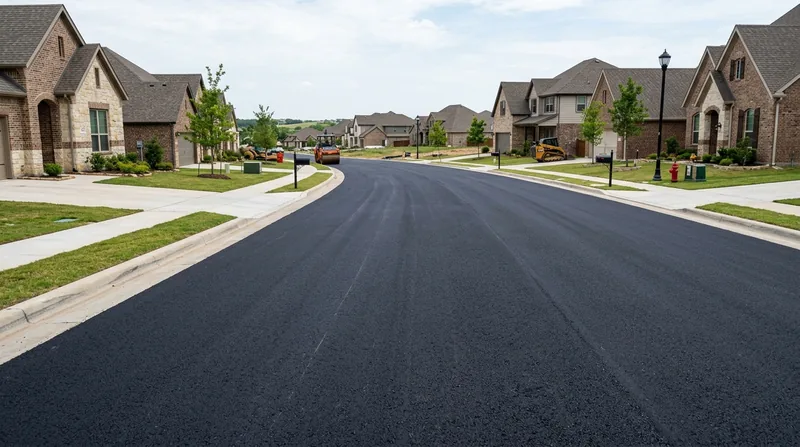




Private Road & HOA Paving in Dallas keeps subdivision traffic moving safely across the same shifting clay that defines every driveway in the metroplex. HOA roads in Collin and Denton counties carry concentrated load from dozens or hundreds of homes, all moving through the same wet-dry cycle that cracks single driveways. When the spring rains swell the clay and summer heat pulls it back, the pavement settles, edge cracks spread, and water finds its way into the base. We rebuild the aggregate foundation, lay proper binder and surface courses, and pitch the roadway to shed runoff across the flat subdivision grade. A well-built HOA road holds for 15 to 20 years before resurfacing becomes necessary, and the difference between a road built right and one thrown down fast shows up in year three or four, when the cheap jobs start to fail. We've served Dallas since 2012, and we know the clay, the drainage, and what an HOA board actually needs: a road that works.
Why HOA Road Paving Fails in Dallas (and How to Fix It)
The black clay under Collin and Denton counties swells when wet and shrinks when dry, moving the ground beneath the pavement by a fraction of an inch with every season. A single-car driveway can handle that movement for years, but an HOA road carrying 20 or 30 vehicle trips a day concentrates stress at every weak point. Cracks widen into potholes, the base erodes, and the whole surface begins to fail in sections. Most HOA roads we see have been patched a dozen times, each patch lasting two years before it settles and cracks again. The real fix is not another patch. It is a rebuild from the base up.
- We excavate the failed base material and replace it with compacted aggregate that will not move with the clay.
- We lay a binder course of asphalt that bonds the new base to the surface and distributes load evenly.
- We finish with a top course that sheds water and handles the traffic your community actually sees.
- We pitch the road so runoff flows toward the shoulders and drainage swales, not into the pavement.
A rebuilt HOA road stops the cycle of patching and starts a predictable maintenance clock. That is what an HOA board needs to hear.
Local example: A 12-unit cul-de-sac in Frisco with a failing asphalt road saw six patches in five years before the board called us. The base was gone. We removed 4 inches of failed pavement and base, reset the grade, compacted new aggregate, and laid 3 inches of asphalt. The road has held for four years now with zero maintenance. The board's annual repair budget went to zero.
See how we handle asphalt resurfacing and overlay work when the base is still sound. For roads where the base has failed, full-depth replacement is the only honest answer.
How We Rebuild an HOA Road in Dallas: Step by Step
Every HOA road job starts with a site visit, a walk the full length, and an honest look at what is underneath. We measure the failed areas, probe the base, check the drainage, and talk to the board about what the road sees in daily traffic. Then we give you a written estimate with tonnage specs, the depth we are laying, and the timeline. We do not guess on price or on what we are going to do.
- We mark utilities with Texas 811 before any excavation, because the law requires it and because hitting a water line or gas line stops the job and costs everyone money.
- We remove the failed pavement and base material in sections, haul it off, and grade the subgrade flat and true.
- We compact new aggregate base in lifts, proof-roll it with a loaded truck to verify it will not move, and check the grade with laser level.
- We lay binder course asphalt, compact it hot, and let it cool before the surface course goes down.
- We finish with the top course, broom-finish the shoulders for drainage, and mark the edges so residents see where the road ends.
The whole job, from excavation to final compaction, takes one to two weeks depending on the road length and weather. We do not work in heavy rain because wet base material will not compact correctly, and we do not lay asphalt when the temperature is below 50 degrees.
Real example: A private road in McKinney serving eight homes was settling at the low point near a culvert. The base had washed out under the pavement. We removed 18 tons of failed material, reset the grade with proper slope toward the culvert, compacted 22 tons of new base, and laid 28 tons of asphalt in two lifts. The road now sheds water correctly and the settling has stopped.
We also handle gravel driveway installation and grading for rural roads and private lanes where asphalt is not the right choice. The base-prep work is the same: get the grade right, compact it, and let it hold.
HOA Road Paving Methods: What Works in Dallas
| Approach | Description | Best For |
|---|---|---|
| Full-Depth Replacement | Remove all failed pavement and base, reset grade, compact new aggregate, lay binder and surface courses. | Roads with base failure, extensive alligator cracking, or more than 40 percent of surface failed. |
| Asphalt Overlay | Mill the top inch or two of failed pavement, compact the remaining base, and lay new asphalt on top. | Roads where the base is still solid and surface cracking is moderate (less than 30 percent alligatored). |
| Recycled Asphalt Base | Remove failed pavement, crush it on-site, compact it as new base material, and lay fresh asphalt surface. | Budget-conscious HOAs where material cost matters and the base layer does not need to be virgin aggregate. |
| Selective Patching & Seal | Fill potholes and cracks with asphalt patch, compact, and finish with a light seal coat for appearance. | Temporary fix only for roads with less than 20 percent failed surface and a few more years of life expected. |
Each method has a place, and the right choice depends on how much of the road has failed, how much the base has moved, and what the HOA board can afford to spend now versus later. We walk the road with you and tell you which method will actually work.
Private Road & HOA Paving Cost in Dallas: What to Expect
HOA road paving in Dallas starts at around 15,000 to 20,000 dollars for a short cul-de-sac or a single lane serving four to six homes. A full subdivision road serving 20 or 30 homes runs 40,000 to 75,000 dollars depending on length, width, and how much of the base needs to be replaced. Those numbers assume standard asphalt, proper base preparation, and a road that is not on a steep slope or in a flood zone. If the road has a bad culvert, poor drainage, or sits in clay that is actively moving, the base prep work costs more and takes longer.
The biggest cost driver is the condition of what is underneath. A road with a solid base and surface cracking only costs less to fix than a road where the base has washed out or settled unevenly. We measure the failed area, calculate the tonnage of material we need to remove and replace, and give you a written estimate with those numbers on it. That is how you compare us fairly to other bids: you see the tons of base, the depth of asphalt, and the price per ton. A bid that does not include tonnage specs is a guess, and you should not trust it.
Travel and site visits are included in our service area across Dallas, Plano, Irving, Arlington, Fort Worth, McKinney, Frisco, and surrounding communities. We do not charge a separate mileage fee. The estimate is free and comes within 24 hours of your call to (469) 949-4815. There is no obligation to book.
See our full pricing overview for detailed breakdowns of other services we handle.
What to Look for When Hiring an HOA Paving Contractor Near Dallas
An HOA board has a duty to spend money wisely, and that means vetting any contractor before the work starts. Ask for references from other HOAs the contractor has worked for, and call those references to ask how the road has held up. Ask for a written estimate that includes the depth of asphalt, the tonnage of base material, and the timeline. Ask whether the contractor is fully insured, and ask to see the certificate. Do not accept a verbal estimate or a price that sounds too good to be true, because the only way to get a price that low is to skip steps or use less material than the road needs.
Check with your city or county about permits and right-of-way rules. Some municipalities require a permit for any work on a private road that connects to a public street, and some do not. Your HOA board may have architectural standards that govern what material or color the road can be. Verify those rules before you get bids so the contractor knows what he is working within. Ask the contractor whether he has pulled permits in your jurisdiction before, because that tells you he knows the local rules.
Paving scams in this market typically show up as unsolicited door-to-door offers, a price quoted over the phone with no site visit, a request for a large cash deposit before work starts, and out-of-state plates on the truck. Those are all warning signs. A legitimate contractor comes to your property, measures the work, gives you a written estimate with material specs, and waits for you to decide. We have been in Dallas since 2012, and we work local. Call us at (469) 949-4815 to get a free estimate and see what a properly detailed bid looks like.
Learn more about what goes into asphalt driveway paving and installation if you are also considering work on individual driveways within your HOA community.
Private Road & HOA Paving in Dallas: Pricing Guide
| Service | Price | Details |
|---|---|---|
| Short HOA road or cul-de-sac (4-6 homes, under 200 linear feet) | Starting at $15,000 | Full-depth replacement with new aggregate base, binder, and surface course, including base prep and drainage. |
| Standard subdivision road (8-20 homes, 200-500 linear feet) | Starting at $35,000 | Full-depth replacement or overlay depending on base condition, proper grading, and runoff management for flat terrain. |
| Large HOA road or private lane (20+ homes, 500+ linear feet) | Starting at $65,000 | Comprehensive base rebuild, proper slope, culvert work if needed, and multi-course asphalt with full compaction specs. |
| Overlay or partial repair (solid base, surface cracking only) | Starting at $8,000 | Milling, new asphalt surface, and drainage correction without full excavation, cost depends on road length and width. |
| Estimate and site visit | Free | Written estimate with tonnage specs, depth, timeline, and material breakdown delivered within 24 hours of your call. |
Indicative pricing, the exact cost depends on square footage, finish, and site access. Free personalized estimate within 24h at (469) 949-4815.


