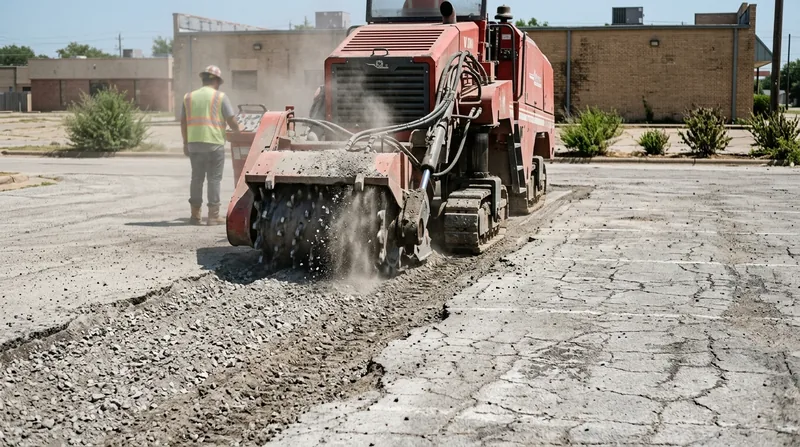




Asphalt Milling & Removal in Dallas is the foundation work that comes before a new driveway or parking lot surface. When your pavement has failed past the point of a simple overlay, when alligator cracking runs deep, or when the base has shifted under the black clay that dominates Dallas soils, milling removes the old asphalt layer by layer down to a sound, graded surface ready for new hot mix. Dallas homeowners and property managers across North Dallas, Oak Cliff, Lakewood, and the newer subdivisions pushing into Collin and Denton counties face the same problem: the expansive clay beneath shifts with the wet-dry swings of our long summers and spring rains, cracking the surface from underneath. Milling solves that by starting fresh on a stable base. We measure, estimate in writing with tonnage specs, haul off all millings, and grade the surface to specifications before new asphalt goes down. The result is a driveway or lot that will hold for years, not months.
Why Asphalt Milling & Removal Matters in Dallas: The Clay Problem
Dallas driveways sit on deep black clay over Austin Chalk limestone. That clay swells in spring when the water table rises and pulls back in summer heat, opening edge cracks and alligatoring across the surface. A patch holds for a season, but the movement never stops. An overlay on a cracked, failing base lasts two to three years at most because the base is still moving. Milling removes the failed layer entirely, reveals the base condition, and gives you a clean slate. For driveways in the M Streets, Lakewood, and Oak Cliff, where narrow lots and sloped terrain demand precision, and for the wider mid-century ranch drives across North and East Dallas now showing decades of clay movement, milling is often the only repair that justifies the cost.
- We mill down to sound asphalt or base, removing the entire failed layer in a single operation.
- We haul off all millings and grade the exposed surface to proper slope and compaction.
- The graded surface is ready for new hot mix asphalt or an alternative surface material.
- Milling eliminates the weak base that causes patches and overlays to fail prematurely.
Starting over on a solid base costs more upfront but saves money over the life of the driveway because you are not throwing repair dollars at a surface that will crack again in six months.
Local example: A 1960s ranch driveway in North Dallas, 24 feet wide and 40 feet long, shows alligator cracking across 60% of the surface and edge cracks running the full length. An overlay would cost $2,100 and last two years. Milling to base, proper grading, and new asphalt runs $4,200 to $5,000 and holds for 12 to 15 years. The math favors milling.
For guidance on whether your driveway is a candidate for milling or for a simpler repair, see our page on driveway repair. If the base is still sound and cracking is surface-only, a resurfacing or overlay may be the right answer.
How We Mill and Remove Asphalt in Dallas: The Process
Milling is a controlled removal process. We bring in a milling machine that grinds the asphalt layer by layer, revealing the condition of the base as we go. The machine is self-loading, so the millings are captured and hauled away in real time. Once the failed layer is removed, we grade the exposed surface to proper slope, compact it where needed, and prepare it for the next phase. The entire job from start to finish, for a typical residential driveway, takes one to two days depending on size and access. We work with your local building department on any permit requirements and always call for a Texas 811 utility locate before we begin.
- We perform a site visit, measure the area, and assess the base condition before quoting.
- We call for a Texas 811 utility locate to identify underground gas, electric, and water lines.
- We mill the failed asphalt layer down to sound base or subgrade, adjusting depth as conditions dictate.
- We grade and compact the exposed surface to proper slope and bearing capacity.
- We haul all millings off-site for recycling or disposal per local regulations.
- The finished surface is ready for new hot mix asphalt or other surface material within 24 hours.
The key to a long-lasting result is milling deep enough to remove all the failed material and then grading the base so water drains away and the new surface sits on a stable, compacted foundation.
Real case: A parking lot in Garland, 15,000 square feet, had failed edge cracking and rutting in the drive lanes. Milling revealed a 4-inch base layer that was intact but undersized for the traffic load. We milled to 5 inches of stable base, compacted it, and paved with 3 inches of new hot mix over a geotextile, creating a stronger structure. The lot now handles the traffic without rutting.
If you are considering a full driveway replacement, milling is the first step. For parking lots, see our parking lot paving and parking lot repair pages for context on when milling is the right choice.
Milling Methods and When to Use Each
| Approach | Description | Best for |
|---|---|---|
| Full-depth milling | Remove all asphalt layers down to subgrade or to a stable base layer, mill to exact depth specified, compact and grade the result. | Driveways and lots with extensive alligator cracking, failed bases, or when you need a clean slate for new paving or gravel. |
| Partial milling (mill and inlay) | Mill down 2 to 3 inches of the top layer to remove surface cracking and rutting while leaving the lower, stable layers intact. | Surfaces with surface-only damage and a solid base, or as a prep step before a thick overlay on a structurally sound drive. |
| Milling with base repair | Mill to base, identify soft or failed spots, remove and replace weak sections with compacted stone or recycled asphalt, then grade for new paving. | Driveways with settlement, edge drop-off, or localized base failure from clay movement or poor drainage. |
| Milling with grading and drainage | Mill the surface, regrade to improve drainage, compact the base, and prepare for new asphalt with proper slope to shed water. | Lots and driveways with ponding, edge cracking from trapped moisture, or where water is accelerating the failure. |
The right milling approach depends on what the base looks like after the failed asphalt is removed. We assess that on site and recommend the method that gives you the longest service life for the money spent.
Asphalt Milling & Removal Cost in Dallas: What to Expect
Milling costs in Dallas run from $1,500 for a small residential driveway (under 500 square feet) to $5,000 to $8,000 for a mid-size drive or small parking lot, and higher for large commercial lots. The main factors that move the price are the size of the area, the depth of milling required, the condition of the base (soft or stable), access for the milling machine, and whether the site requires grading or base repair after milling. A driveway in a tight lot in Lakewood or the M Streets, where access is narrow and the slope is steep, costs more to mill than the same square footage on a wide, flat lot in a North Dallas subdivision. Hauling costs depend on how far the site is from our yard and the volume of material to remove.
Every job gets a written estimate that includes the area to be milled, the depth, the estimated tonnage of material to be removed, and the cost. We do not quote per square foot because milling is not a commodity operation. The base condition, the machine time, and the haul distance all vary. Two driveways of the same size can have different costs if one has a solid base and the other has soft spots that need additional work.
To get an accurate number for your property, request a free estimate. We measure on site, assess the base, and provide a written quote within 24 hours. For a full pricing overview and examples of what different scopes cost, see our pricing page.
Asphalt Milling & Removal Near Me: What Dallas Homeowners Should Know When Hiring
Hiring a paving contractor for milling requires the same care as any major home improvement. You want someone local, someone who understands Dallas clay and the specific challenges of your neighborhood, and someone who will give you a written estimate and explain what you are paying for. Verify that any contractor you call is fully insured and carries general liability and workers compensation. Ask for references from recent jobs in your area, and call them. Ask whether the contractor will pull any required permits or help you navigate local requirements, because permitting rules vary by city. If your driveway is in an HOA community, check your architectural guidelines before you start, because some HOAs restrict milling or require approval before removal work begins.
- Verify that the contractor is fully insured with general liability and workers compensation coverage.
- Ask for a written estimate that specifies the area to be milled, the depth, tonnage, and total cost.
- Request references from recent milling jobs and call them to ask about quality and timeline.
- Confirm that the contractor will coordinate with your city on any required permits or right-of-way approvals.
- Check your HOA architectural rules if you live in a master-planned community, because milling approval varies.
- Ask about the hauling plan for millings and whether recycling or disposal is included in the quote.
A contractor who provides a detailed written estimate, answers your questions clearly, and explains the condition of your base is the one to trust. Contact us to discuss your driveway or lot and get a free, no-obligation estimate. We serve Dallas, Plano, Irving, Garland, Arlington, Fort Worth, McKinney, Frisco, and surrounding areas.
Asphalt Milling & Removal in Dallas: Pricing Guide
| Service | Price | Details |
|---|---|---|
| Small residential driveway milling | Starting at $1,500 | Under 500 square feet, full-depth milling to stable base, includes hauling and grading |
| Mid-size driveway or small parking lot | Starting at $3,500 | 500 to 1,200 square feet, milling depth and base condition assessed on site, hauling included |
| Large parking lot or complex milling | On estimate | Requires site visit to assess base, access, and depth; price depends on tonnage and hauling distance |
| Milling with base repair or drainage work | On estimate | Additional cost for soft spots, grading, or compaction beyond standard milling, quoted after site assessment |
| Free estimate | No charge | Written quote with tonnage specs and detailed breakdown, response within 24 hours at (469) 949-4815 |
Indicative pricing, the exact cost depends on square footage, finish, and site access. Free personalized estimate within 24h at (469) 949-4815.


